
My first post on The Chess Improver: The Value of Thematic Complete Games Against a Weaker Opponent
Today is my debut as a contributor to the blog The Chess Improver, thanks to the invitation of GM Nigel Davies to join in the sharing of ideas and observations about improving at chess (and even more generally, other endeavors as well). I will be regularly writing about chess there instead of here.
Note that although the blog does not support comments, Nigel Davies hosts lively discussions about each blog post on Facebook through his account.
Both participant and observer
Since it turns out that I have just finished two of the six rounds in the current Pittsburgh Chess Club Tuesday night tournament, the 15th Fred Sorensen Memorial, I began my debut by using my first round game as material for a post to beginn a discussion about “learning from imperfectly played games that, however, illustrate chess themes well”.
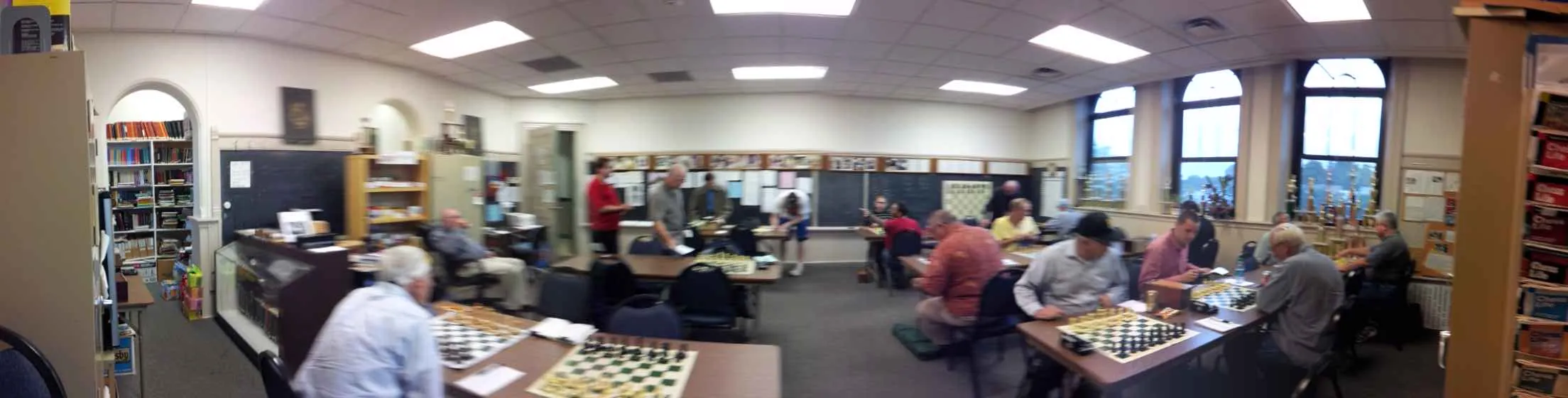
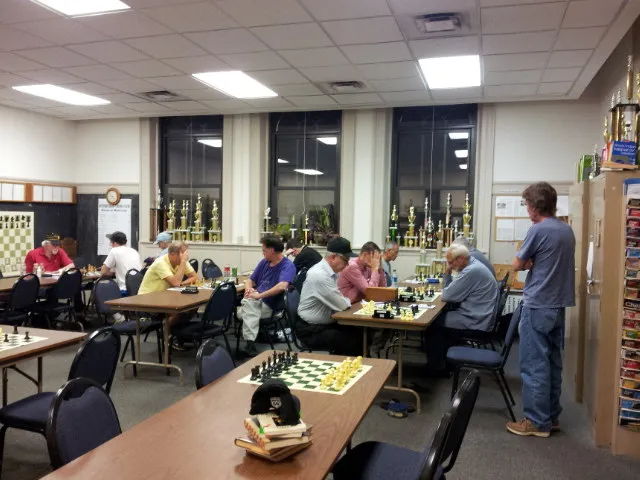
I will have a post up next week about my second round game of this week, which was quite interesting. I will not always be writing about my own games on the blog, of course. They just happen to be, right now, a timely source of relevant material, since I am in the middle of a tournament.
Previous chess writings
Since I have not played tournament chess since winning the 2013 Pittsburgh Chess Club Championship in February, if you have discovered this blog only recently, you may be interested in exploring my previous chess writings.
(The original Chess Improver site is no longer active; the rescued article follows below.)
One of the paradoxes for the intermediate level chess improver is that very often, focusing on studying well-annotated top-level games, such as in the excellent anthology The Mammoth Book of the World’s Greatest Chess Games, backfires. This is because the games are so subtle and dominated by sharp tactical turns, that the chess improver find its hard to apply the lessons to everyday practical play.
One good piece of advice that has often been given on this blog has been to study older games, such as those by José Capablanca and Akiba Rubinstein, in which the greats of the past faced weaker competition. But even this is not ideal, because “weaker” in this context is still stronger than the average club player today. I feel that what can be truly valuable is the study of games in which one can identify with the loser, but at the same time also aspire to be the winner (where the winner is not a super-strong Master or better).
Through a lower-level game, one can learn how to see through the eyes of the thematic play of the stronger player while learning how to avoid the faulty defensive play of the weaker player. It is instructive to study how to gradually press home a plan against a clearly weaker opponent, because in club chess, what I hear often after a game is “I knew I was better at this point but didn’t know how to proceed”. It is more important, at club level, to have a clear idea of how to transition well into the middlegame and endgame against imperfect opposition, than to know how to handle the best possible responses in some sharp opening line; if you don’t know how to win against weaker moves and plans, how can you learn to win against strong ones?
I offer the following game, which I played this week in the first round of a Tuesday night tournament at the Pittsburgh Chess Club, as an example of this kind of instructive game, from the opening through the endgame. (The players were rated USCF 1703 and 2164.) The game illustrates the successful use of the Rubinstein Variation of the English Opening by Black, through the classic Maroczy Bind Pawn structure:
-
how to create the bind in the opening, characterized by the c and e Pawns
-
how to defend both the c and e Pawns against counterplay while continuing development into the middlegame
-
how to punish attempted too-late counterplay by winning material
-
how to finish off a won endgame (often just called “a matter of technique”, but it’s not over till it’s over, especially in club play)
The lessons for White involve seeing:
-
missed opportunities to play more actively in the opening
-
the dangers of creating exploitable Pawn weaknesses on the Queen side
-
the folly of attempting “freeing” play too late, when the opponent has already prepared to handle it